<?xml version="1.0" encoding="UTF-8"?>
<rss version="2.0"
	xmlns:content="http://purl.org/rss/1.0/modules/content/"
	xmlns:wfw="http://wellformedweb.org/CommentAPI/"
	xmlns:dc="http://purl.org/dc/elements/1.1/"
	xmlns:atom="http://www.w3.org/2005/Atom"
	xmlns:sy="http://purl.org/rss/1.0/modules/syndication/"
	xmlns:slash="http://purl.org/rss/1.0/modules/slash/"
	>

<channel>
	<title>Ayahuasca.com &#187; peru</title>
	<atom:link href="http://www.ayahuasca.com/tag/peru/feed/" rel="self" type="application/rss+xml" />
	<link>http://www.ayahuasca.com</link>
	<description>Homepage of the Great Medicine</description>
	<lastBuildDate>Wed, 07 Jul 2010 18:19:07 +0000</lastBuildDate>
	<generator>http://wordpress.org/?v=2.9.2</generator>
	<language>en</language>
	<sy:updatePeriod>hourly</sy:updatePeriod>
	<sy:updateFrequency>1</sy:updateFrequency>
			<item>
		<title>Ayahuasca: Peruvian National Cultural Heritage</title>
		<link>http://www.ayahuasca.com/news/ayahuasca-national-cultural-heritage/</link>
		<comments>http://www.ayahuasca.com/news/ayahuasca-national-cultural-heritage/#comments</comments>
		<pubDate>Sat, 16 Aug 2008 11:55:52 +0000</pubDate>
		<dc:creator>Steve Beyer</dc:creator>
				<category><![CDATA[News]]></category>
		<category><![CDATA[Shamanism]]></category>
		<category><![CDATA[culture]]></category>
		<category><![CDATA[heritage]]></category>
		<category><![CDATA[peru]]></category>
		<category><![CDATA[tradition]]></category>

		<guid isPermaLink="false">http://www.ayahuasca.com/?p=58</guid>
		<description><![CDATA[The Peruvian National Institute of Culture resolved that indigenous ayahuasca rituals — “one of the fundamental pillars of the identity of Amazonian peoples” — are part of the national cultural heritage of Peru, and are to be protected, in order to ensure their cultural continuity.]]></description>
			<content:encoded><![CDATA[<p>On June 24, 2008, in a document apparently first published on July 14, the Peruvian National Institute of Culture resolved that indigenous <em>ayahuasca</em> rituals — “one of the fundamental pillars of the identity of Amazonian peoples” — are part of the national cultural heritage of Peru, and are to be protected, in order to ensure their cultural continuity. The National Institute of Culture is charged by statute with recording, publishing, and protecting the Peruvian national cultural heritage.</p>
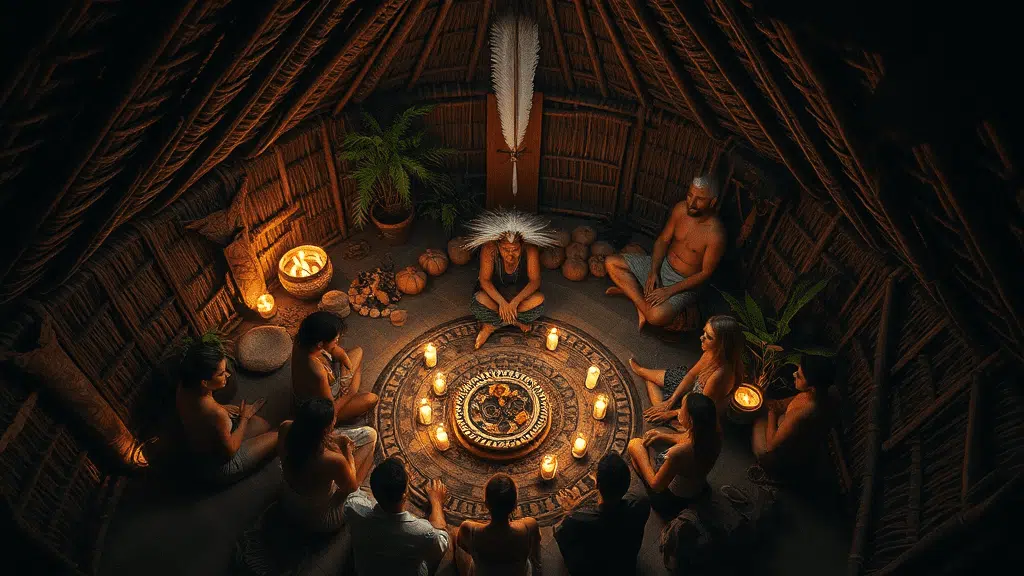
<p>The resolution explicitly differentiates the traditional use and sacred character of indigenous <em>ayahuasca</em> rituals from “decontextualized, consumerist, and commercial western uses.”</p>
<p>The resolution is based on a May 29, 2008, report originally submitted by Rosa Giove Nakazawa, a physician at the Takiwasi Center in Tarapoto, to the Regional Bureau for Economic Development, a local governmental entity in the <em>departamento</em> of San Martin. The Takiwasi Center is a medical facility investigating the treatment of addictions using traditional Amazonian medicine, including <em>ayahuasca</em>.</p>
<p>The Resolution states that <em>ayahuasca</em> is &#8220;a plant species with an extraordinary cultural history, by virtue of its psychotropic qualities and its use as a drink combined with the plant known as <em>chacruna</em>.” This plant, the Resolution says,</p>
<blockquote><p>is known to the indigenous Amazonian world as a wise or teaching plant, which shows to initiates the very foundations of the world and its components. The effect of its consumption is to enter into the spiritual world and its secrets … The effects of <em>ayahuasca</em>, widely studied because of their complexity, differ from those usually produced by hallucinogens. Part of this difference consists in the ritual which accompanies its consumption, which leads to a variety of effects which are always within culturally defined limits, and with religious, therapeutic, and culturally affirmative intentions.</p></blockquote>
<p>It is not clear to me what legal effect this resolution has, or what powers the National Institute of Culture has to enforce it, or whether this means that support is available for additional research and publication on <em>ayahuasca</em> rituals, or whether the resolution is intended to encourage or discourage <em>ayahuasca</em> tourism.</p>
<p>It is also not clear what impact — if any — the resolution might have on drug prosecutions in the United States; but, given the specific disclaimer language cited above, it might make it more difficult for North Americans to claim religious exemptions from US drug laws.</p>
<p>The complete text of the resolution is <a href="http://el-durru.blogspot.com/2008/07/per-declaran-ayahuasca-como-patrimonio.html">here</a>.</p>
]]></content:encoded>
			<wfw:commentRss>http://www.ayahuasca.com/news/ayahuasca-national-cultural-heritage/feed/</wfw:commentRss>
		<slash:comments>0</slash:comments>
		</item>
	</channel>
</rss>